
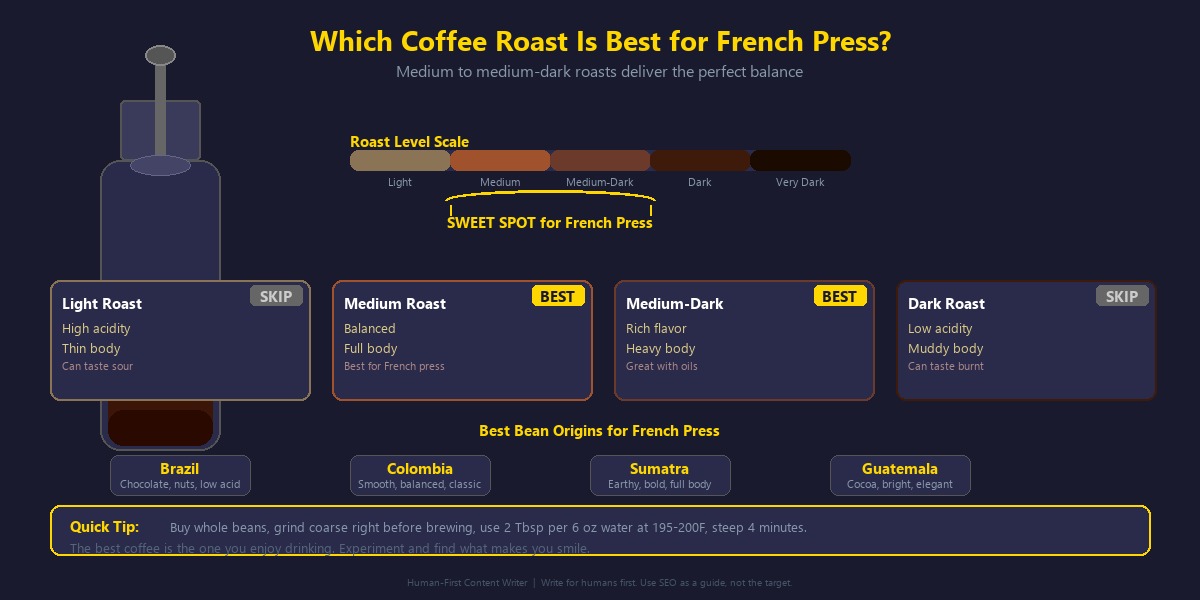
If you own a French press, you already know it makes a rich, full-bodied cup. But have you ever thought about whether you’re using the right beans? The truth is, the roast level matters just as much as the brewing method. Pick the wrong one and your coffee can taste flat, sour, or burnt. Pick the right one and every sip is smooth and delicious, and you’ll wonder why you didn’t make the switch sooner.
So which roast works best? The short answer is medium to medium-dark roasts. But there is a lot more to it. Let us break down exactly why these roasts shine in a French press and how to pick the perfect bean for your next brew.
Why French Press Needs a Different Roast
Here is something a lot of people don’t realize. A French press doesn’t use a paper filter. It uses a metal mesh instead, and that changes everything about how your coffee tastes. You would be surprised how many people overlook this simple fact.
Paper filters trap the natural oils and fine particles that come from the beans, but metal filters let all of those things through instead. So when you brew with a French press, you get a much heavier, richer cup with more body and texture, and every single flavor note from the bean ends up right there in your mug.
That is great news if you love bold coffee. But it also means you have to be more careful about which roast you choose. Light roasts can taste too sharp or grassy when the oils are not filtered out. Dark roasts can taste burnt or ashy because the metal filter doesn’t soften them the way paper does. Medium and medium-dark roasts hit the sweet spot. They have just enough development to smooth out the acidity without going so dark that they turn bitter.
Roast Levels Explained
Before we get into the best choice, let us look at the main roast levels and how they behave in a French press.
Light roast. These beans are roasted for a short time at lower temperatures. They keep most of their original flavors, which means you can taste things like fruit, citrus, or floral notes. Light roasts have high acidity and a lighter body, so in a French press that acidity can feel sharp and overwhelming because there is no paper filter to soften it. If you have tried a light roast in your press and thought it tasted sour, that is exactly why it happened.
Medium roast. The beans are roasted a bit longer, usually to around 410 to 430 degrees. The acidity starts to mellow, and the body gets fuller and more rounded. You get a nice balance between the bean’s natural flavor and the roast flavor. This is one of the best choices for French press, and it’s the safest option if you’re not sure what to buy.
Medium-dark roast. These beans show a bit of oil on the surface. The roast flavor is more forward, with notes like chocolate, caramel, toasted nuts, or a hint of spice. The body is heavy and rich, which pairs perfectly with the French press, so if you like a bold, full cup that still has some character, this is definitely your roast.
Dark roast. The beans are shiny with oil, and the roast flavor takes over completely. You taste smoke, dark chocolate, and charcoal more than you taste the bean itself. In a French press, dark roasts can taste flat. The heavy oils from the beans plus the natural oils from the press create a muddy, overpowering cup.
The Best Roast for French Press
Medium to medium-dark roasts are hands down the best choice for French press coffee. Here is why.
First, they have enough body to stand up to the rich texture of French press coffee. The metal filter lets all the oils through, which makes your coffee feel thick and smooth. Medium roasts have just the right amount of oil to make this work.
Second, they have balanced acidity. Light roasts can taste too sharp for many people. Dark roasts can taste too bitter. Medium roasts land right in the middle, with a pleasant brightness that adds life to your coffee without overwhelming it.
Third, they bring out the best flavor notes for this method. Think chocolate, nuts, caramel, dried fruit, and a touch of sweetness. These flavors absolutely shine in a French press because the brewing process extracts them fully and the metal filter keeps all of that goodness in your cup.
Top Bean Origins for French Press
Some origins work especially well with the French press. Here are the ones you should look for.
Colombia. This is a classic choice for a reason. Colombian beans are medium-bodied with balanced acidity and notes of chocolate and nuts. They are smooth, consistent, and work perfectly in a French press.
Brazil. Brazilian beans are naturally low in acidity and heavy in body. They taste like chocolate and roasted nuts with a smooth, creamy finish. Some even have a hint of peanut or butter. This is one of the best origins for French press because the low acidity and heavy body match the method so well.
Sumatra. If you like bold, intense coffee, Sumatra is for you. These beans are earthy and full-bodied with very low acidity. In a French press, they produce a thick, almost syrupy cup. It’s not for everyone, but fans of dark, powerful coffee will love it.
Guatemala. These beans are well-balanced with a medium body, bright but not sharp acidity, and notes of cocoa and subtle fruit. They make a smooth, elegant French press coffee that is easy to drink black.
Ethiopia (natural processed). Ethiopian beans can be tricky with a French press. Light roasted versions are very fruity and acidic. But don’t write them off. A medium roasted natural Ethiopian can be incredible in a French press, with berry and wine notes that feel rich and complex.
What to Avoid
Some beans just don’t work well with this method. Here is what to skip.
Very light roasts. They are too acidic and taste thin in a French press. Without a paper filter to soften the brightness, you end up with a sharp, sour cup. Save your light roasts for pour-over or drip coffee.
Very dark roasts. They taste burnt and flat. The heavy oils from the beans combine with the natural oils from the press to create a muddy taste that hides any interesting flavors. If you drink dark roast in a French press and wonder why it tastes like ash, now you know why.
Overly oily beans. If the beans look greasy, they have been roasted very dark. The oil on the surface is a sign that the bean structure has broken down. These beans will produce a flat cup in a French press.
Pre-ground supermarket coffee. Most pre-ground coffee is ground for drip machines, which use a medium grind. French press needs a coarse grind. Using pre-ground coffee in a French press means the fine particles will slip through the mesh and end up as sludge in your cup. Buy whole beans and grind them yourself.
Grind Size and Brewing Tips
Even the best roast will not save you if your grind size is wrong. French press needs a coarse grind. The pieces should look like breadcrumbs or sea salt.
If the grind is too fine, the coffee slips through the filter and makes your cup muddy and bitter. If it is too coarse, the water can’t extract enough flavor and your coffee ends up weak.
Buy whole beans and grind them yourself right before you brew. A burr grinder set to a coarse setting gives you the best results.
Use about 2 tablespoons of coffee for every 6 ounces of water. That is a good starting point for most medium roasts. Heat your water to around 195 to 200 degrees. If you boil it, let it sit for 30 seconds before pouring. Steep for exactly 4 minutes, then press slowly. Pour right away so it doesn’t keep extracting.
Quick Tips for Your Next French Press
Here is a simple plan for your next coffee purchase.
Look for bags labeled medium or medium-dark roast. Check the tasting notes. Chocolate, nuts, caramel, and cocoa are all good signs that the coffee will work well with your press.
Try single-origin beans from Brazil or Colombia first. They are forgiving and taste great with this method. Once you get comfortable, try Sumatra or Guatemala.
Grind your beans coarse right before you brew. Use the right water temperature and steep time. That combination works with almost every medium roast.
And here is the most important tip. The best coffee is the one you enjoy drinking. Use this guide as a starting point, but don’t be afraid to experiment. Try a medium roast from Guatemala one week and a darker roast from Sumatra the next. See which one makes you smile. That is the right answer.
Leave a Reply