
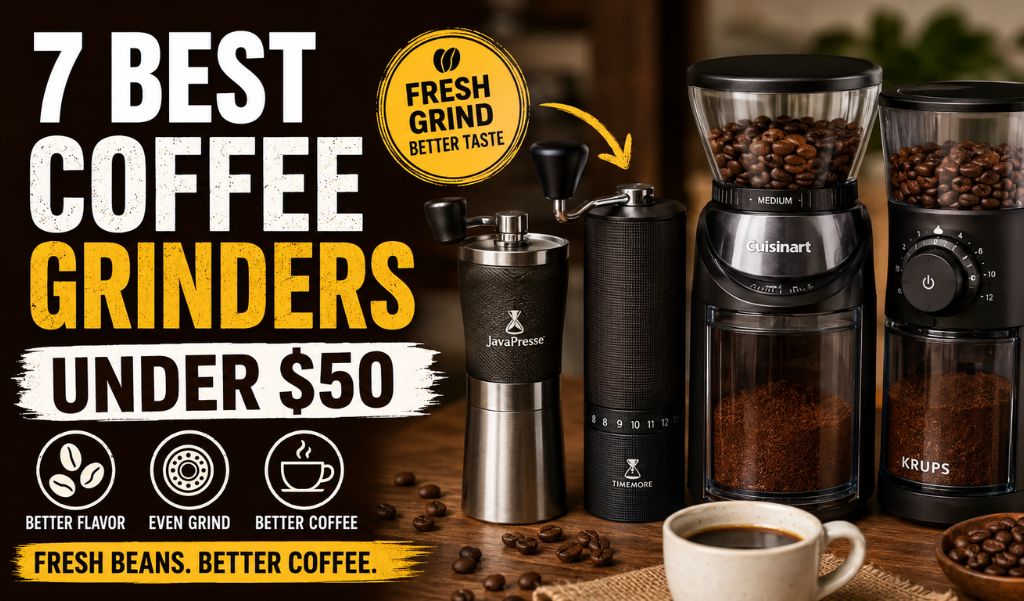
A good coffee grinder is the single best upgrade you can make to your morning coffee. Freshly ground beans taste way better than pre-ground coffee, and you don’t need to spend a lot of money to get started since the smell and flavor are much better when you grind your own beans.
Lots of great coffee grinders on Amazon cost less than $50, and some are electric while others are hand crank so each one works best for other needs. This guide covers the seven best options, explains what to look for, and helps you pick the right one.
Why a Good Coffee Grinder Matters
Coffee starts losing flavor just minutes after you grind it because the bean oils that make coffee taste great escape when the beans are broken down. Store-bought pre-ground coffee has already lost most of that flavor before you even open the bag.
When you grind fresh at home, all of that good flavor stays in the cup and you can even use cheaper beans while still getting better tasting coffee because it’s so fresh.
Not all grinders work the same way though, because a good one gives you even bits but a bad one makes not even pieces that over-extract and taste bitter or under-extract and taste sour. That’s why the grinder often matters more than the coffee maker you use.
Buying Guide: What to Look for Under $50
Here is what you need to know before you buy, and these tips will help you pick the best grinder for your needs.
Burr vs. Blade
This is the biggest choice you will make. Burr grinders use two rough parts that crush the beans into even pieces. Blade grinders use a spinning blade that chops the beans up and gives you uneven results.
Burr grinders are better for flavor and blade grinders cost less, so under $50 you can find basic electric burr models as well as good manual ones. Blade grinders are cheaper but they don’t give you the same even results.
For most people, a hand burr grinder is the best value under $50. You get even grind size without paying for a motor.
Manual vs. Electric
Hand grinders need you to turn a handle and take about 30 to 60 seconds for one cup, but they are quiet, easy to carry, and often cost less than electric models with the same grind.
Electric grinders are faster and easier to use, most when you make more than one cup at a time. Under $50, electric burr grinders tend to have more plastic parts and less even grind than hand burr grinders at the same price.
Think about how much time you want to spend each morning. If you want speed, go electric. If you want the best grind for the money, go manual.
Grind Settings
More grind settings mean you can use the grinder for more types of coffee. For French press you need a coarse grind, pour-over calls for a medium grind, and espresso needs a fine grind.
Under $50, most electric grinders offer 10 to 18 settings. Manual grinders often have a dial that lets you make very small changes. If you use other brew types, look for at least 10 settings.
Build
Under $50, you will mostly find plastic bodies and ceramic or steel burrs, and ceramic burrs are common at this price because they stay sharp longer than steel but are more brittle and grind a bit slower.
Plastic bodies work fine for daily use but they may not last as long as metal ones. If you plan to use the grinder every day for years, think about spending a bit more or getting a hand model with a metal body.
Capacity
Think about how much coffee you make at once. Most hand grinders hold 20 to 30 grams of beans, which makes one or two cups. Electric grinders usually hold more, around 4 to 8 ounces in the top hopper.
If you make coffee for a few people every morning, an electric grinder with a bigger hopper makes more sense.
7 Best Coffee Grinders Under $50 on Amazon
Here are the seven best coffee grinders you can buy for under $50. They are ranked from the most budget-friendly to the best value.
1. Krups GX4100 Electric Burr Grinder
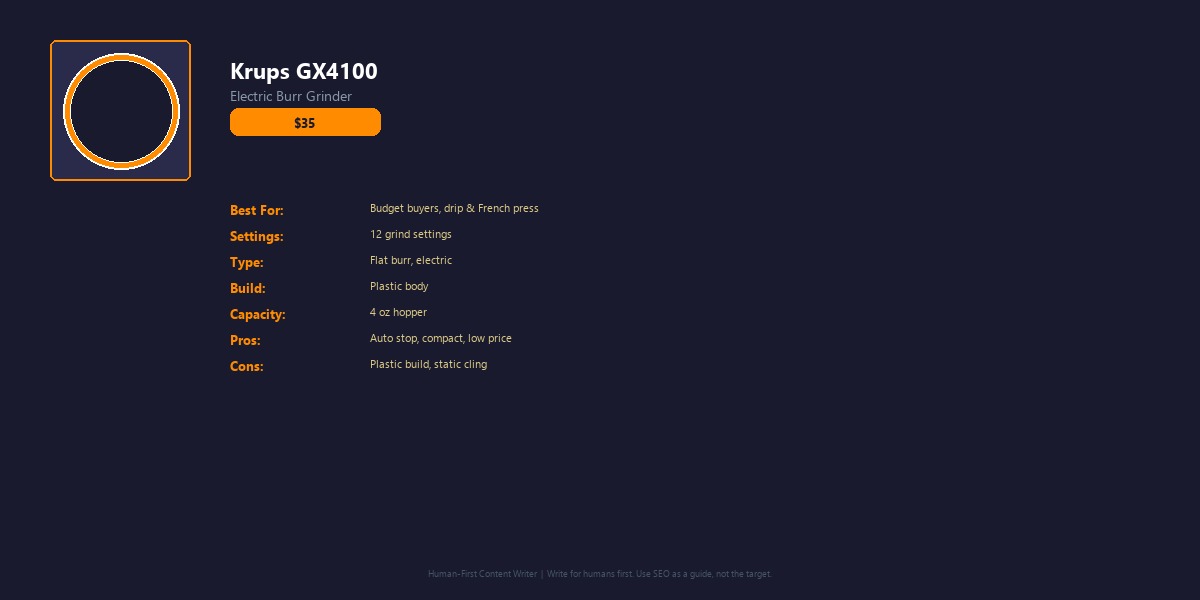
The Krups GX4100 is one of the cheapest electric burr grinders you can buy. It uses a flat burr system with 12 settings, so you can go from fine to coarse with no trouble.
The hopper holds about 4 ounces of beans, which works for several cups. The grinder stops on its own when the chamber is full, so you don’t have to watch it.
Pros. Low price, 12 grind settings, auto stop, small size.
Cons. Plastic build feels light, static makes grounds stick to the cup, louder than hand grinders.
Best for. Anyone who wants an electric burr grinder on a tight budget. It works well for drip coffee and French press.
2. Mr. Coffee IDS77 Electric Blade Grinder
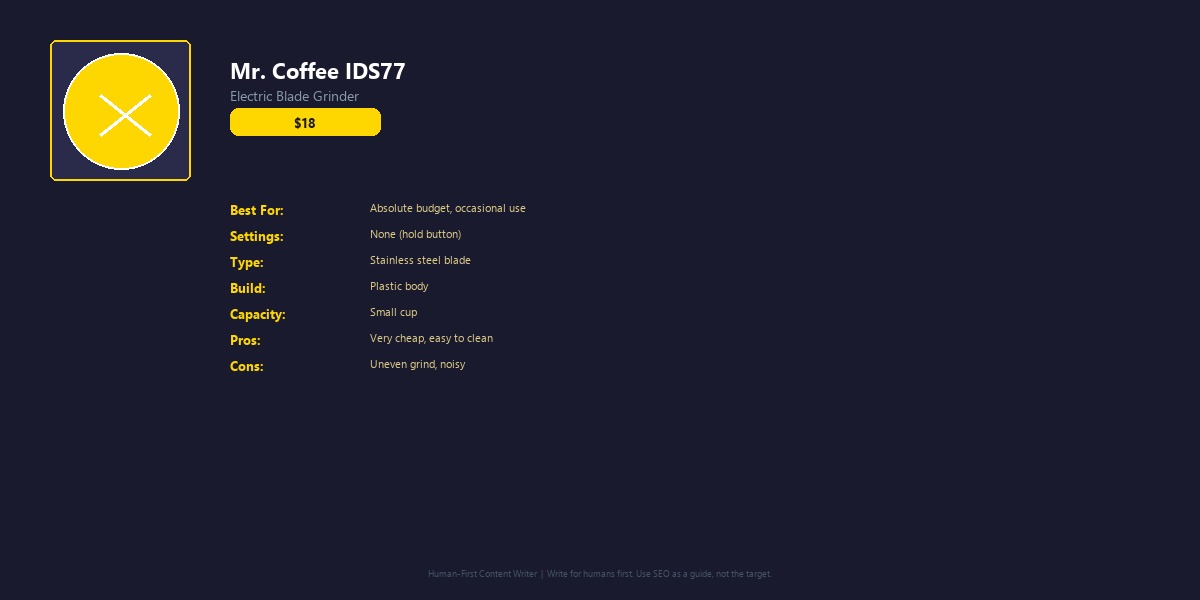
The Mr. Coffee IDS77 is a simple blade grinder that has been around for years. It has a stainless steel blade, a cup you can take off for cleaning, and one-button use.
You control the grind by holding the button down longer or shorter, where a few seconds gives you a coarse grind and ten to fifteen seconds gives you a fine grind.
Pros. Very cheap, easy to clean, small, good.
Cons. Grind size is not even, noisy, no settings to pick from, can heat up the beans if you run it too long.
Best for. Budget buyers or someone who only grinds coffee now and then. Not great for pour-over or espresso where you need even grinds.
3. Hamilton Beach 80335 Electric Burr Grinder
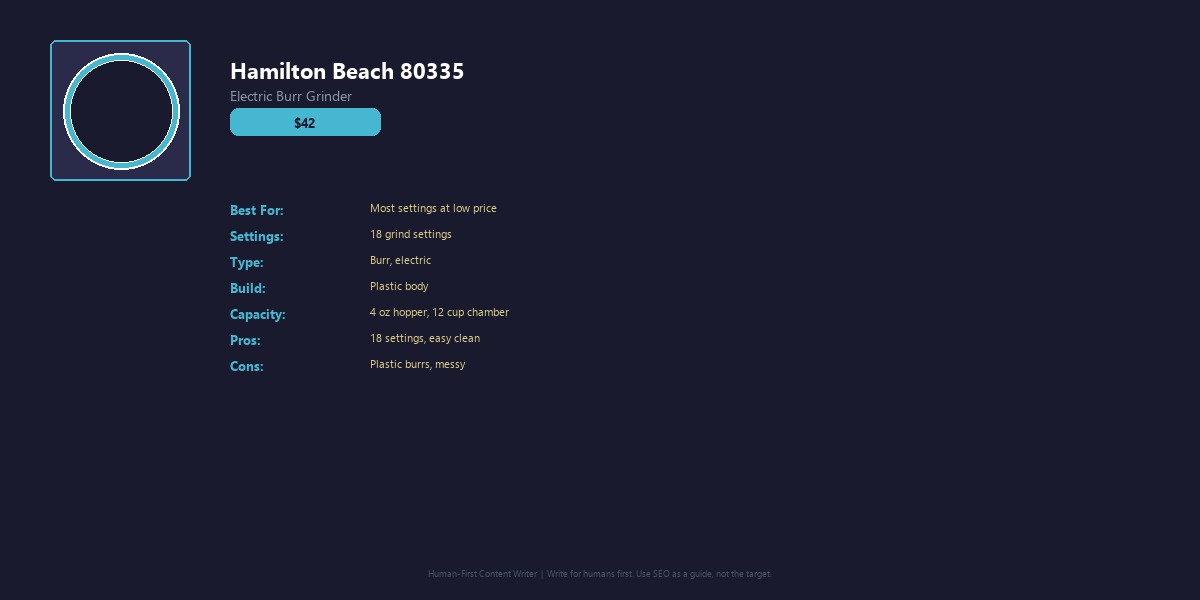
The Hamilton Beach 80335 is a step up from the Krups in how it’s built. It uses a burr grinding system with 18 settings, which is more than most grinders at this price.
The grinding chamber comes off for easy cleaning and holds enough for 12 cups of coffee. The hopper holds 4 ounces of beans. There is a simple dial on the front to pick your grind size.
Pros. 18 grind settings, chamber you can clean, good value.
Cons. Plastic burrs instead of ceramic or steel, some people say the coarse grind is not always even, can be messy.
Best for. Anyone who wants the most grind settings under $50. Works for drip, pour-over, and French press.
4. Cuisinart DBM-8 Electric Burr Grinder
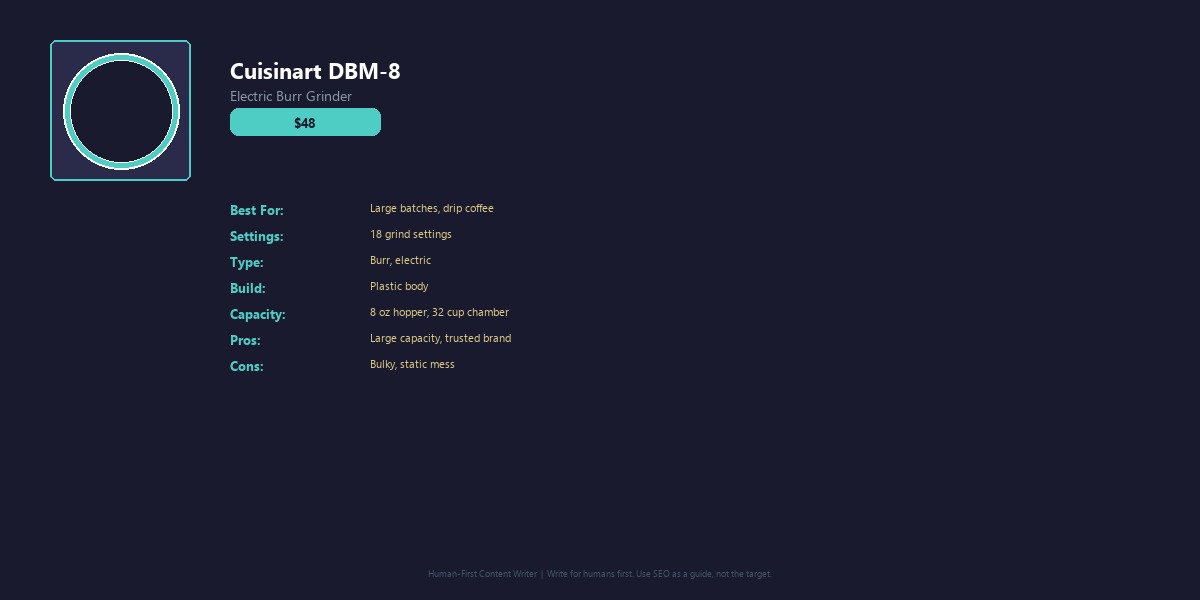
The Cuisinart DBM-8 is one of the most well known electric burr grinders on Amazon. It has 18 grind settings, an 8 ounce bean hopper, and a grind chamber that comes off and holds enough for 32 cups.
The dial on the front is easy to read and adjust. The chamber slides out so you can pour and clean it without mess. The lid seals tight to keep grounds from spilling.
Pros. Big size, even grind at medium settings, trusted brand, easy to clean.
Cons. Takes up counter space, static can make a mess, coarse grinds are less even than fine or medium ones.
Best for. Households that make a few cups of coffee every day. Works best with drip coffee makers.
5. JavaPresse Manual Coffee Grinder
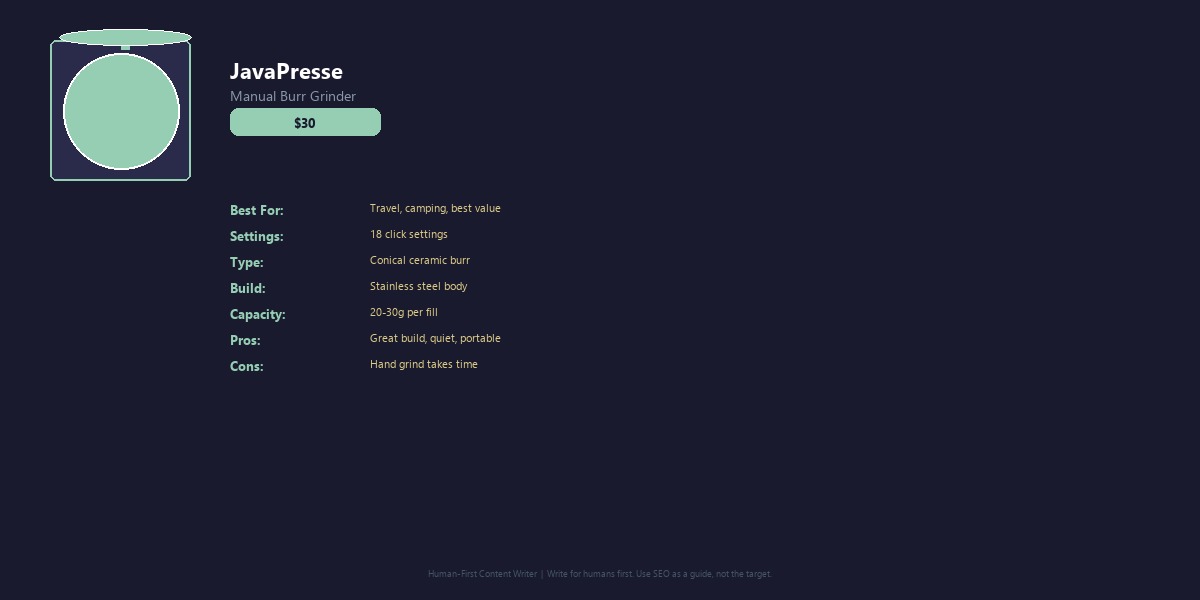
The JavaPresse is a manual burr grinder with a ceramic conical burr and 18 grind settings. It is small, easy to carry, and has a stainless steel body that feels much nicer than the price would make you think.
The grind setting is on the bottom of the grinder where you turn the dial to pick what you need, and it can go from fine enough for espresso to coarse enough for French press.
Pros. Good build for the price, even grind, light, quiet, 18 settings.
Cons. Takes 30 to 60 seconds of hand grinding per cup, small size, can be tiring for more than one or two cups.
Best for. Travel, camping, or daily use for one or two cups. Best value under $50 for grind.
6. Hario Skerton Plus Ceramic Burr Grinder
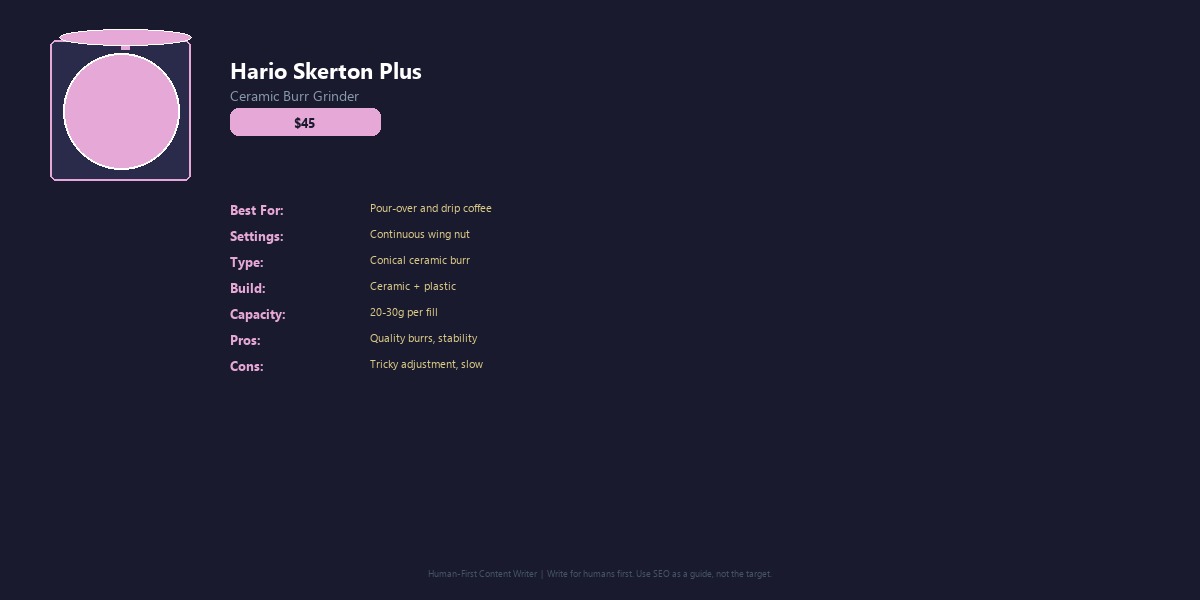
The Hario Skerton Plus is an improved version of the classic Hario Skerton. It has a ceramic conical burr and a better steady plate that keeps the grind more even than the old model.
The grind setting uses a wing nut on the bottom. It takes a few tries to get used to it. The range covers all types from espresso fine to French press coarse.
Pros. Good ceramic burrs, better stable than the old one, well-known brand, even grind.
Cons. Grind setting is a bit tricky, slower than other manual grinders, some plastic parts on the body.
Best for. Coffee lovers who want a good manual grinder. Works well for pour-over and drip.
7. Timemore C2 Manual Burr Grinder
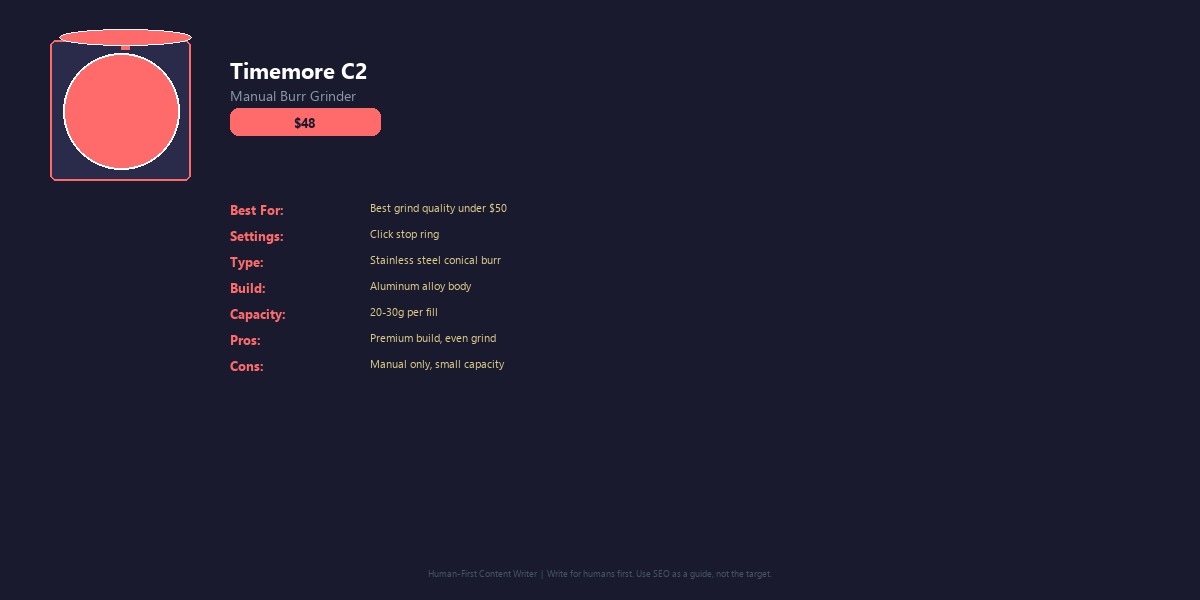
The Timemore C2 has become a favorite among coffee fans for its build and even grind at a low price. It comes with a stainless steel conical burr set, a full metal body, and a hand crank that feels good to use.
The grind setting uses a threaded ring at the bottom with clear click stops. The grind is very good for the price, matching grinders that cost twice as much.
Pros. Top build, stainless steel burrs, very even grind, easy to use, compact.
Cons. Manual only, small size, price is near the top of the budget range.
Best for. Serious coffee drinkers who want the best grind under $50. Great for pour-over and Aeropress.
Comparison Table
Here is a quick look at all seven grinders side by side.
| Grinder | Type | Settings | Build | Best For | Price |
|---|---|---|---|---|---|
| Krups GX4100 | Electric Burr | 12 | Plastic | Budget electric | $35 |
| Mr. Coffee IDS77 | Electric Blade | None | Plastic | Budget | $18 |
| Hamilton Beach 80335 | Electric Burr | 18 | Plastic | Most settings | $21 |
| Cuisinart DBM-8 | Electric Burr | 18 | Plastic | Large batches | $38 |
| JavaPresse | Manual Burr | 18 | Stainless steel | Travel and value | $34 |
| Hario Skerton Plus | Manual Burr | Continuous | Ceramic + plastic | Pour-over | $38 |
| Timemore C2 | Manual Burr | Click stops | Metal | Best grind | $48 |
Which One Should You Buy?
Here is how to pick based on what matters most to you.
If you want the best grind under $50. Get the Timemore C2. It gives you the most even grind in this price range. The metal body feels great and the stainless steel burrs will last a long time.
If you want an electric grinder for easy use. Get the Cuisinart DBM-8. It has a large size, 18 settings, and a trusted brand name. It’s the best electric option under $50.
If you want the best value. Get the JavaPresse manual grinder. For about $30, you get stainless steel build, 18 settings, and even grind. It’s a great deal.
If you’re on a tight budget. Get the Krups GX4100. It’s the cheapest electric burr grinder out there and it still does a good job for drip coffee and French press.
If you travel or camp. Get the JavaPresse. It’s small, light, and doesn’t need any power. You can take it anywhere.
Common Questions
Is a manual grinder worth it under $50?
Yes. Manual grinders often give you more even grinds than electric grinders at the same price because they don’t need to spend money on a motor. The Timemore C2 and JavaPresse are two good examples.
Can I use a blade grinder for French press?
You can, but the results won’t be very even. Blade grinders make a mix of fine dust and big chunks. The fine bits over-extract and taste bitter while the big chunks under-extract and taste sour. A burr grinder works much better for French press.
How long does a manual grinder take?
About 30 to 60 seconds for one cup, depending on the grind size. Coarse grinds for French press take less time. Fine grinds for espresso take longer.
Are ceramic burrs better than steel?
Ceramic burrs stay sharp longer but they are more brittle and grind slower. Steel burrs last longer and grind faster but they can wear down after many years of use. Both types work well at this price.
Can I grind for espresso under $50?
Some manual grinders like the Timemore C2 and Hario Skerton Plus can grind fine enough for espresso, but the setting may not be exact enough for fine-tuning. If espresso is your main method, think about saving up for a special espresso grinder.
Which grinder is the quietest?
Manual grinders are much quieter than electric ones. The JavaPresse and Timemore C2 make almost no noise compared to electric models.
Final Thoughts
You don’t need to spend hundreds of dollars to get great coffee at home. Any of the seven grinders on this list will make your coffee taste better than pre-ground beans. The key is to pick the one that fits how you brew and what you need.
If you drink pour-over or use an Aeropress, a manual burr grinder like the Timemore C2 or JavaPresse will give you the best flavor for the money. If you make big batches of drip coffee every morning, an electric model like the Cuisinart DBM-8 will save you time.
The most important thing is to start grinding fresh. Once you taste the difference, you won’t go back to pre-ground coffee.
Leave a Reply