
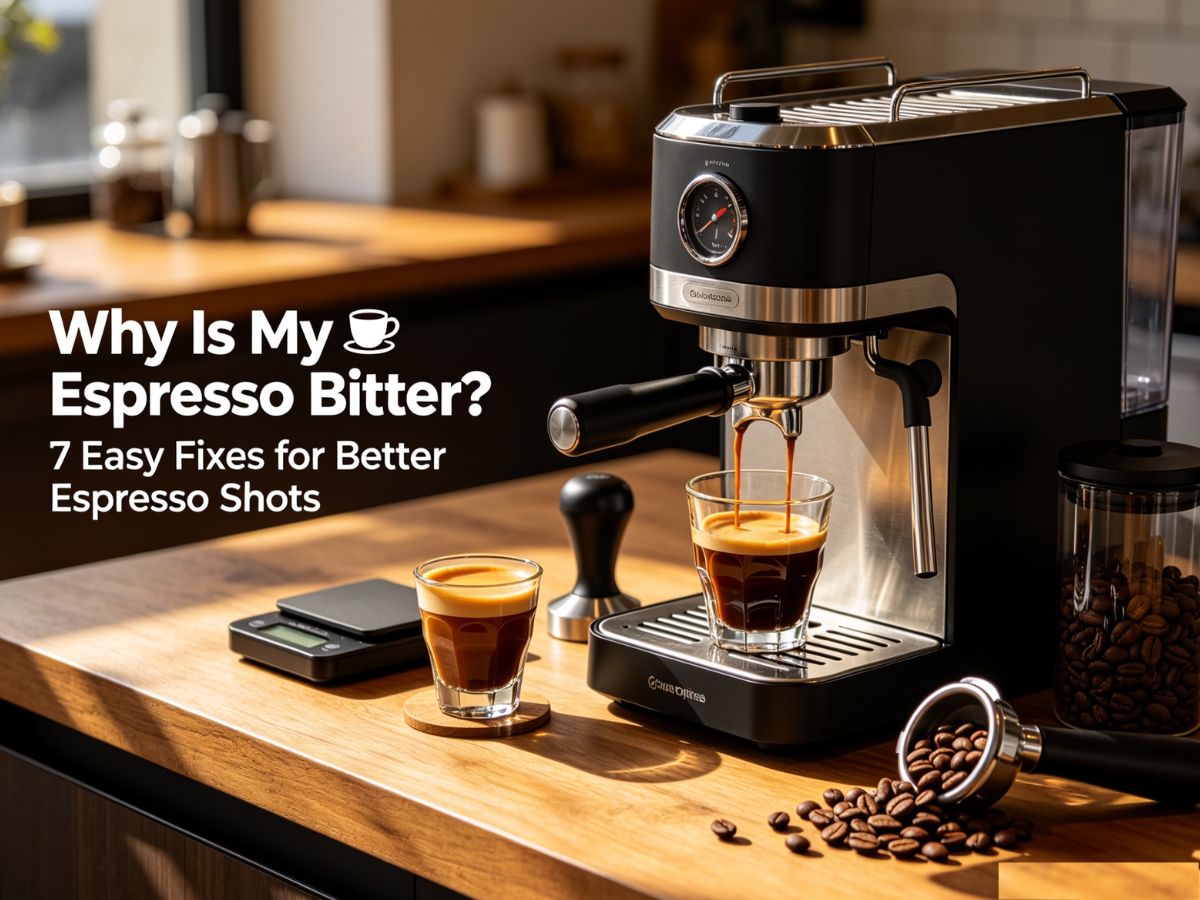
Bitter espresso ruins the morning ritual for many home baristas. This guide explains the main causes and gives you seven practical fixes for better shots.
Simply put, bitter espresso usually means over-extraction – water pulls too many harsh compounds from the coffee. The most common culprits are grind too fine, water too hot, brew time too long, or stale beans. Fix the extraction and the bitterness disappears.
Key Takeaways
- Over-extraction causes bitterness when water dissolves too many tannins and harsh compounds from the coffee grounds.
- Grind size is the single most influential variable – too fine creates excessive resistance and over-extraction.
- Water temperature above 205 degrees Fahrenheit scorches the coffee and extracts bitter notes rapidly.
- Fresh beans roasted within the past four weeks produce significantly less bitterness than stale coffee.
- Clean equipment prevents rancid oils from contaminating every shot you pull.
Quick Comparison: Common Causes vs Fixes
| Cause | Symptom | Primary Fix |
|---|---|---|
| Grind too fine | Slow drip, dark crema, 35+ sec | Coarsen grind 2-3 clicks |
| Water too hot | Harsh bite, burnt aroma | Lower temp to 195-205°F |
| Brew time too long | Thin body, lingering bitterness | Target 25-30 seconds |
| Stale beans | Flat flavor, hollow bitterness | Use beans 3-30 days post-roast |
| Dirty portafilter | Rancid aftertaste every shot | Backflush daily, deep clean weekly |
| Channeling | Spraying, uneven extraction | WDT, level tamp, check puck |
| Dark roast beans | Inherent roast bitterness | Switch to medium roast |
Fix 1: Coarsen Your Grind Size
Grind size controls how fast water flows through the coffee puck. Too fine and water struggles, over-extracting bitter compounds. According to the Specialty Coffee Association, ideal extraction yield sits between 18 and 22 percent. Finer grinds push extraction past 22 percent where harsh tannins dominate.
Tip: Adjust your grinder one click coarser at a time. Pull a shot after each change. Stop when the shot runs 25 to 30 seconds with steady flow like warm honey.
Most home grinders like the Baratza Sette 270, Niche Zero, or Eureka Mignon have enough resolution for micro-adjustments. If your shot chokes the machine or drips slower than one drop per second, the grind is too fine. Coarsening by two to three clicks typically adds five to eight seconds to shot time and reduces bitterness immediately.
- Start with a baseline dose of 18 grams for a double basket.
- Time the shot from first drip to 36 grams yield.
- Adjust grind until you hit 25 to 30 seconds consistently.
- Taste each adjustment – bitterness should fade as extraction drops into range.
Fix 2: Lower Your Brew Temperature
Water temperature directly affects extraction speed and compound solubility. The Specialty Coffee Association recommends 195 to 205 degrees Fahrenheit for balanced extraction. Many home machines like the Breville Barista Express or Gaggia Classic Pro run hotter by default, often exceeding 210 degrees at the group head.
Important: If your machine has PID control panel access your settings and drop the brew temperature by two to three degrees. For machines without PID control, flush the group head for five seconds before locking in the portafilter to bleed off superheated water.
Darker roasts benefit from lower temperatures – try 195 to 200 degrees. Lighter roasts can handle 203 to 205 degrees. A simple thermometer or Scace device verifies actual group head temperature. Reducing temperature by just three degrees can eliminate burnt, ashy bitterness without sacrificing body.
- Check your machine manual for temperature adjustment method.
- Flush group head before every shot on non-PID machines.
- Test 198 degrees for medium-dark roasts, 203 for light roasts.
- Record temperature and taste notes for each bean.
Fix 3: Shorten Your Shot Time
Shot duration correlates directly with extraction. The industry standard targets 25 to 30 seconds for a double shot yielding 36 grams from 18 grams of coffee. Shots running past 35 seconds almost always taste bitter because water continues extracting undesirable compounds after the sweet spot passes.
Warning: Do not chase yield weight at the expense of time. Stopping a shot at 30 seconds with 30 grams is better than 40 seconds for 36 grams. Time is the harder constraint.
If your shot runs long, coarsen the grind first. If grind is already coarse enough, reduce dose by half a gram. A VST 18g precision basket or IMS competition basket improves flow uniformity and reduces the chance of channeling that artificially extends shot time. Consistent puck preparation – distribution, leveling, tamping – keeps times repeatable.
- Weigh dose and yield for every shot.
- Time from first drip to target yield.
- If over 30 seconds, coarsen grind one click.
- If still over 30 seconds at coarsest practical grind, reduce dose 0.5g.
- Verify flow looks like mouse tails, not a fire hose or slow drip.
Fix 4: Use Fresher Coffee Beans
Stale coffee oxidizes and loses aromatic compounds while developing flat, bitter flavors. The Coffee Quality Institute states that roasted coffee peaks between three and thirty days post-roast. After thirty days, volatile oils degrade and bitterness becomes more pronounced regardless of brew technique.
Tip: Buy coffee with a roast date printed on the bag. Avoid bags with only a “best by” date. Use beans within four weeks of roast. Store in an airtight container like Fellow Atmos or Airscape away from light and heat.
Supermarket beans often sit for months. Local roasters or subscription services like Trade Coffee, Blue Bottle, or Counter Culture ship within days of roasting. If you must use older beans, grind coarser and lower temperature to compensate for increased solubility, but expect diminished complexity.
- Check roast date before buying – aim for 3 to 14 days post-roast.
- Buy only what you will use in two to three weeks.
- Freeze excess beans in vacuum-sealed portions for long-term storage.
- Allow frozen beans to reach room temperature before opening container.
Fix 5: Clean Your Equipment Thoroughly
Rancid coffee oils accumulate on portafilters, baskets, shower screens, and group heads. These oxidized oils impart a distinct stale, bitter flavor to every shot. Daily backflushing with water and weekly chemical cleaning with Cafiza or Urnex removes this buildup.
Important: Backflush daily with a blind basket. Weekly, use half a teaspoon of espresso machine cleaner. Scrub the shower screen and gasket with a brush. Soak portafilters and baskets in hot water with cleaner for fifteen minutes monthly.
Machines with three-way solenoid valves like the Rancilio Silvia, La Marzocco Linea Micra, or Lelit Elizabeth require backflushing. Lever machines and some entry-level models without solenoids need manual group head scrubbing. A clean machine reveals the true flavor of your coffee without the overlay of old oils.
- Run blank shots (no coffee) through the group head each morning.
- Backflush with blind basket for ten seconds on, ten seconds off, repeat five times.
- Weekly: add cleaner, backflush same cycle, rinse until water runs clear.
- Remove shower screen monthly for deep cleaning.
- Replace group gasket annually or when leakage appears.
Fix 6: Fix Channeling and Puck Preparation
Channeling occurs when water finds paths of least resistance through the puck, over-extracting those channels while under-extracting the rest. The result is simultaneous sourness and bitterness. Barista Hustle research shows even minor channeling reduces extraction uniformity by 15 to 20 percent.
Tip: Use the Weiss Distribution Technique (WDT) with a fine needle tool to break clumps before tamping. Tap the portafilter sides gently to settle grounds. Tamp level with 30 pounds pressure – consistency matters more than force.
Tools like the Crema WDT tool, Normcore distributor, or Pullman tamper improve puck prep. A bottomless portafilter reveals channeling instantly – look for spraying or blonding in specific spots. Even distribution eliminates localized over-extraction that tastes bitter.
- Dose into portafilter, then WDT for ten seconds.
- Tap portafilter on tamping mat twice to settle.
- Level with distributor or finger swipe.
- Tamp straight down, no twisting, until resistance stops.
- Inspect puck after shot – it should be dry and intact, not soupy or cracked.
Fix 7: Choose the Right Roast Level
Dark roasts contain more inherent bitterness from carbonized sugars and degraded chlorogenic acids. The Italian Espresso National Institute defines traditional espresso as medium-dark, but modern specialty coffee favors medium roasts that preserve origin character and natural sweetness.
Warning: If you use oily, very dark beans labeled “espresso roast,” bitterness is baked in. No grind or temperature adjustment fully fixes roast-level bitterness. Switch to a medium roast from a specialty roaster for cleaner flavor.
Medium roasts from roasters like Heart Coffee, George Howell, Onyx Coffee Lab, or Sey Coffee highlight acidity and sweetness. They require finer grinds and higher temperatures but reward you with complexity instead of charcoal notes. If you prefer traditional Italian-style espresso, accept some bitterness as characteristic – but ensure it’s roast bitterness, not extraction bitterness.
- Identify roast level by bean color – medium is milk chocolate, dark is dark chocolate to black.
- Oily surface indicates very dark roast.
- Medium roasts need 1-2 clicks finer grind than dark roasts.
- Expect brighter acidity – pair with milk if too sharp.
- Taste black before adding milk to evaluate true flavor.
How to Diagnose Your Specific Issue
Not every bitter shot has the same cause. Use this systematic approach to isolate the variable responsible for your why does my espresso taste bitter problem.
- Pull a shot with your current settings. Record dose, yield, time, temperature.
- Taste and note flavor profile – burnt, ashy, hollow, medicinal, lingering.
- Change only grind size. Coarsen two clicks. Pull and taste.
- If improved, grind was the issue. If not, reset grind and lower temperature three degrees.
- If still bitter, check bean roast date. Switch to fresher beans.
- If beans are fresh, deep clean machine and retry.
- If bitterness persists, examine puck for channeling. Improve distribution.
- As last resort, try a different coffee – some beans are naturally more bitter.
Important: Change one variable at a time. Changing grind and temperature together masks which fix worked. Keep a logbook or phone note with settings and taste notes for each session.
Common Myths vs Facts
Myth: Bitter espresso means you need more coffee
Fact: Increasing dose without adjusting grind makes the puck thicker, slowing flow and increasing over-extraction. More coffee usually makes bitterness worse, not better.
Myth: Tamping harder fixes bitter shots
Fact: Excessive tamp pressure compacts the puck unevenly, creating density variations that cause channeling. Consistent 30-pound pressure with level distribution works better than maximum force.
Myth: All espresso should taste bitter
Fact: Properly extracted espresso balances sweetness, acidity, and bitterness. Bitterness should be a supporting note like dark chocolate, not the dominant flavor. The World Barista Championship scoring sheets reward balance, not bitterness.
Frequently Asked Questions
Why does my espresso taste bitter even with fresh beans?
Fresh beans can still taste bitter if over-extracted. Check grind size, water temperature, and shot time. According to the Specialty Coffee Association, extraction yield above 22 percent produces bitterness regardless of bean freshness.
How do I know if my grind is too fine?
Shot time exceeding 35 seconds for a standard double, flow that drips instead of streams, and puck that stays wet and muddy after extraction all indicate grind is too fine.
Can water quality cause bitter espresso?
Yes. High mineral content, especially bicarbonates, can amplify perceived bitterness. Use filtered water with 50-150 ppm total dissolved solids. The Specialty Coffee Association water standards recommend 75-250 ppm TDS for optimal extraction.
Should I use a pressurized or non-pressurized basket?
Non-pressurized baskets give you control over grind and extraction. Pressurized baskets mask grind inconsistency but limit flavor clarity. For fixing bitterness, non-pressurized with a quality grinder produces better results.
How often should I replace my burrs?
Steel burrs dull after 500-800 kg of coffee. Ceramic burrs last longer but can fracture. Dull burrs produce more fines, which over-extract and cause bitterness. Replace burrs when shots become inconsistent despite good technique.
Final Thoughts
Bitter espresso almost always traces back to over-extraction from grind, temperature, or time. Fresh beans and clean equipment remove the other common causes. Dial in one variable at a time and taste methodically. The seven fixes here solve 90 percent of bitter shots.
Leave a Reply