
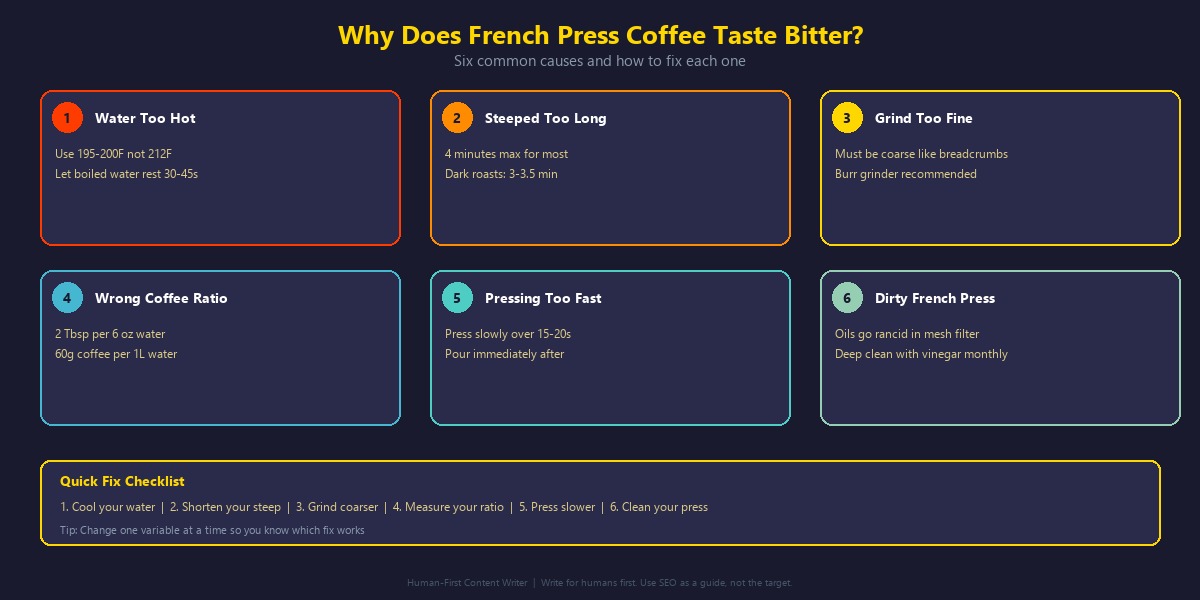
You bought good beans. You followed the instructions. But your French press coffee still tastes bitter. What is going on?
This is one of the most common frustrations with French press brewing. The good news is that bitterness is almost always caused by one of a few specific problems, and each one is easy to fix. In this guide, you will learn the six most common reasons for bitter French press coffee and exactly what to do about each one.
1. Water Is Too Hot
This is the number one cause of bitter French press coffee. Water straight off a boil at 212 degrees scorches the grounds, forcing out bitter compounds before the good flavors develop. It is like burning meat on the outside while the inside stays raw.
The ideal brewing temperature for French press is 195 to 200 degrees Fahrenheit. If you don’t have a thermometer, bring your water to a full boil and then let it sit for 30 seconds before pouring. That simple step drops the temperature to about 205 degrees. Wait another 10 to 15 seconds and you’re right in the sweet spot.
You can also try this test. If your coffee tastes bitter but also feels thin or weak, the water was probably too hot. The heat extracted bitter compounds quickly but didn’t give the good flavors enough time to come out.
2. Steeped Too Long
French press is an immersion brewer, which means the coffee sits in the water the whole time. The longer it sits, the more flavor gets pulled out. After about four minutes, you start extracting bitter compounds that ruin the taste.
If you’re steeping for five minutes or longer, the coffee becomes over-extracted and bitter. This happens because the water keeps pulling compounds from the grounds, and after about four minutes the good flavors are gone and the harsh ones take over.
The standard steep time for French press is four minutes. Set a timer and stick to it. If you like a stronger cup, adjust the coffee ratio instead of the steep time. Use more grounds instead of steeping longer. This gives you more flavor without the bitterness.
Dark roasts are especially sensitive to steep time because they are more porous and extract faster. If you’re using a dark roast, try reducing your steep time to three or three and a half minutes. You might be surprised how much smoother it tastes.
3. Grind Is Too Fine
Grind size is another major factor. French press needs a coarse grind that looks like breadcrumbs or coarse sea salt. If your grind is medium or fine, two things go wrong at once. First, more surface area means faster extraction, which leads to bitterness even with a normal steep time. Second, fine particles slip through the mesh filter and keep extracting in your cup, adding more bitterness with every sip.
If you buy pre-ground coffee labeled for drip machines, it is probably too fine for French press and will cause bitterness, since drip coffee uses a medium grind that works with paper filters but not metal mesh. The best solution is whole beans ground coarse in a burr grinder, because blade grinders create uneven particles that extract inconsistently.
4. Wrong Coffee to Water Ratio
Using too many grounds can also cause bitterness. The standard ratio is 2 tablespoons per 6 ounces of water, or about 60 grams per liter. If you’re using 3 or 4 tablespoons for a small cup, some grounds over-extract while others barely get touched, creating inconsistent flavor.
More coffee does not mean a stronger cup, and many people make this mistake. A strong cup has more flavor without the harshness, while a bitter cup comes from bad extraction. Measure your coffee precisely for a few days using a scale to rule this out.
5. Pressing Too Hard or Too Fast
The way you press the plunger matters more than most people realize. If you push down hard and fast, you disturb the grounds at the bottom and force fine particles through the mesh filter. Those particles keep extracting in your cup and release bitter compounds into every sip.
The correct technique is to press slowly and steadily, taking about 15 to 20 seconds to push the plunger all the way down. You should feel gentle resistance but not have to force it. If the plunger is hard to push, your grind is probably too fine.
After pressing, pour the coffee into your mug or a separate carafe right away. Don’t leave it in the press. The coffee at the bottom is still in contact with the grounds and will keep extracting.
6. Letting Coffee Sit After Brewing
This is an easy one to overlook. You press the plunger, but then you leave the coffee in the press while you get your milk or check your phone. By the time you pour, the coffee has been sitting on top of the grounds for several more minutes.
Even though the plunger is pressed down, the liquid at the bottom of the press is still touching the grounds. Over time, those grounds continue to release bitter compounds into the coffee. The longer it sits, the worse it gets.
The fix is simple. Pour all the coffee out of the French press immediately after pressing. Transfer it to a mug, a carafe, or a thermos. Don’t let it sit in the press for more than a few seconds.
If you’re making coffee for one person, this is easy. If you’re making a full pot, pour it into a separate carafe so everyone can serve themselves without the coffee sitting on the grounds.
7. Burnt or Over-Roasted Beans
Sometimes the problem is not your technique, it is your beans. Very dark roasts can taste bitter no matter how carefully you brew. The roasting process breaks down the bean structure and creates bitter compounds that are already present before you add water.
If you’re using a dark roast and your coffee tastes bitter, try switching to a medium or medium-dark roast instead. These roasts have more natural sweetness and acidity, which balances out the flavor. Dark roast fans might prefer a switch to a medium-dark that still has body but less bitterness.
Also check how fresh your beans are. Old coffee loses its natural oils and flavors over time. What is left can taste flat and bitter. Try to use beans within two to four weeks of their roast date. If your coffee has been sitting in the cabinet for months, that might be the problem.
8. Dirty French Press
This is the easiest problem to fix but also the easiest to ignore. Old coffee oils build up on the walls of your French press and inside the mesh filter. These oils go rancid over time and add a stale, bitter taste to your next batch.
If you rinse your French press but rarely give it a deep clean, old residue is probably affecting your coffee. The mesh filter is especially tricky because you can’t see the oils trapped inside it.
Take your French press apart and wash every piece with warm soapy water after each use. Pay special attention to the mesh filter. Scrub it gently with a soft brush or your fingers. Rinse thoroughly.
For a deeper clean, soak the parts in a mixture of white vinegar and warm water once a month. This dissolves any oil buildup that soap alone can’t remove.
Quick Checklist for Fixing Bitter French Press Coffee
Here is a simple list you can follow next time you brew.
Use water at 195 to 200 degrees, not boiling. Let boiled water sit for 30 to 45 seconds before pouring.
Steep for exactly four minutes, not longer. Set a timer. Dark roasts might need three to three and a half minutes.
Use a coarse grind that looks like breadcrumbs. If your grind is medium or fine, that is causing bitterness.
Measure your coffee properly. Use 2 tablespoons per 6 ounces of water or 60 grams per liter.
Press the plunger slowly over 15 to 20 seconds. Don’t rush it.
Pour all the coffee out of the press immediately after brewing. Don’t let it sit.
Switch to medium or medium-dark roasts if you’re using dark roasts and still getting bitterness.
Clean your French press thoroughly after every use, especially the mesh filter.
Try changing one thing at a time. If you adjust everything at once, you will not know which fix worked. Start with the water temperature. That is the most common cause and the easiest to fix. Then move down the list until your coffee tastes the way you want it to.
Bitterness in French press coffee is almost always fixable. It is not the brewing method. It is not your beans most of the time. It is one of these small mistakes that is easy to correct once you know what to look for. Now you know. Go make a better cup.
Leave a Reply